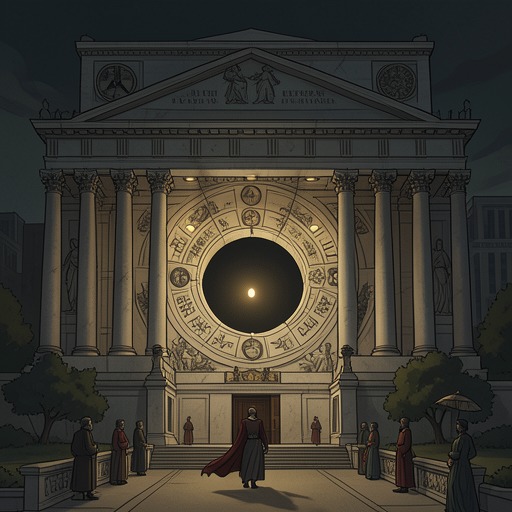
U.S. Capitol cornerstone-laying ceremony
The Lost SymbolThe U.S. Capitol cornerstone-laying ceremony was a Masonic rite conducted by George Washington on September 18, 1793. In the novel, its timing and ritual form make the ceremony more than a construction milestone: it embodies the founders’ use of Masonic tradition and celestial symbolism in shaping the new capital, while later characters interpret it as part of a hidden history embedded in public architecture.
Background and Participants
The ceremony took place within a city conceived and designed by Master Masons, including George Washington, Benjamin Franklin, and Pierre L’Enfant. The novel describes these founders as shaping the capital through Masonic symbolism, architecture, and art. Washington, acting as the nation’s first president and a Mason, performed the cornerstone rite; a later mural depicts him in Masonic regalia at the work.
That history is set against competing ways of reading Washington’s design. Conspiracy theorists claim that the city’s streets conceal secret shapes and messages, but Robert Langdon dismisses such map-based patterns as unreliable: draw enough intersecting lines, he argues, and shapes can be found in almost any city. He distinguishes that speculation from the more concrete historical evidence of Masonic participation in the founding and the ceremony itself.
The Ceremony and Its Timing
The cornerstone was lowered with a tripod and pulley, a method Langdon identifies while teaching from a mural that portrays the event. He dates the ceremony to September 18, 1793, and gives its time as between 11:15 a.m. and 12:30 p.m. The detail matters because the moment was not presented as an arbitrary choice: Langdon explains that Washington, Franklin, and L’Enfant selected it in part because Caput Draconis was in Virgo.
The astrological alignment places the ceremony within a different conception of the heavens from modern popular astrology. In Langdon’s account, the founders treated the positions of the stars and fate as intertwined, and the date and hour of the Capitol’s founding stone reflected that belief. The ceremony therefore joined practical building work to a deliberately chosen celestial moment.
A Repeated Celestial Pattern
Langdon broadens the significance of the Capitol ceremony by comparing it with the cornerstone-laying dates for the White House and the Washington Monument. Although the three structures were begun in different years, he says, their cornerstones were carefully timed to occur under the same astrological condition. The repeated alignment turns the Capitol rite from an isolated curiosity into one instance of a pattern across the principal buildings of the Federal Triangle.
In the novel, this pattern helps explain why Langdon describes Washington as unusually rich in astrological signs, including zodiacs, star charts, and foundations laid at precise celestial moments. His lecture presents these details as historical symbolism, not as proof that street maps encode a single all-encompassing conspiracy. The contrast is central to his method: the ceremony’s documented time and ritual offer specific evidence, while fanciful shapes found by drawing lines across a map do not.
Later Meaning in the Novel
The ceremony becomes part of a larger argument about the capital’s public spaces and their layered histories. When Langdon later explains the Capitol Rotunda to Inoue Sato, he points to its classical and mystical references, including its design as a tribute to Rome’s Temple of Vesta and the former opening in the floor through which a flame in the crypt below could be seen. He also identifies the four-pointed star compass in the crypt as a reminder of that extinguished eternal flame. These details do not alter what happened at the cornerstone ceremony; they show how the novel places it within a capital whose civic buildings carry religious and esoteric imagery in plain sight.
The rite thus stands at the intersection of construction, civic identity, and Masonic tradition. Its lowering of a physical stone anchors the city’s material beginning, while its carefully selected hour gives that beginning a celestial frame. In Langdon’s reading, the ceremony exemplifies the novel’s recurring tension between visible monuments and histories that their everyday visitors may not recognize.